
Alerts Before the Airport: Watching a 349 TH/s Rig From a Phone
A miner who leaves home for a week does not need a dashboard. He needs a message when the machine goes quiet. At 349 TH/s the pool credits about 0.00015656 BTC a day, which is $13.26 at $84,692, or $12.73 once the listed 4% on the block-reward component is applied. Five days of unnoticed downtime is roughly $63 of credits that never arrive.
Key takeaways
- 349 TH/s earns 0.00015656 BTC a day, so a week of silence costs about $88 of gross credits.
- Two alerts cover most failures: hashrate below 80% of normal, and no share for thirty minutes.
- Alerts should be judged after a difficulty change, never on the day the network moves.
- A phone notification is only useful if the payout address behind it is one you control.
What a week away actually puts at risk
Hardware rarely dies loudly. A fan bearing dries out, a power supply derates in a warm room, a pool URL gets a typo during a router reboot. Each of those can leave the machine powered and hashing nothing, which is the worst state for an absent owner because the room still sounds normal. The loss is invisible until a statement is read.
Put a price on the silence. At 349 TH/s the daily credit is 0.00015656 BTC. Multiply by seven and the week is worth 0.00109592 BTC, or $92.80 at the reference price. A machine that stops on the first evening and is found on the sixth morning has already given up five of those days. That is the number the alert is defending, and it dwarfs the cost of the phone and the data plan combined.
The three readings worth a glance
A mining app is not a stock ticker. Three numbers answer almost every question an absent owner has. The first is current hashrate, because it separates "running" from "running properly." The second is the timestamp of the last accepted share, which catches a machine that is online but has stopped submitting. The third is the credit balance, which is the only figure that survives the pool's own accounting.
Hashrate alone can mislead for an hour. Pools smooth the reported figure, and a rig that dropped one board may still show a healthy average for twenty minutes. The share timestamp has no such lag: if the last share is older than the longest expected interval, something has changed. Watch both, but trust the timestamp when they disagree.
Balance is the slowest of the three and the most honest. Under PPS+ the credit arrives hourly against current difficulty, so a steady staircase is the signature of a healthy worker. A flat patch in the balance series is proof, not suspicion, and it is the reading to quote when you ask for help.
Thresholds that survive a difficulty change
The network retargets every 2,016 blocks, roughly every two weeks, and the estimate for the next change on the reference date was −2.12%. A threshold set as an absolute dollar figure will trip on the day the network moves, even though nothing is wrong with the rig. Set the hashrate alert as a percentage of the machine's own recent average instead, and the alert becomes immune to network drift.
Eighty percent is a reasonable floor for a single unit. It catches a dead board or a throttled supply while ignoring the small dips that every miner sees during a heat wave. For a multi-rig account, set the floor per worker rather than on the account total, because one dead unit inside a five-unit total can hide inside a 20% aggregate dip for days.
For the share alert, pick an interval rather than a count. Thirty minutes without an accepted share is long at these difficulties but not absurd; two hours is too generous for a machine earning $12.73 a day, because it burns a tenth of a day before anyone knows. The Profit Calculator gives the daily figure to compare against, which is the honest way to decide how tight the interval should be.
What to do when the message lands at an awkward hour
The first move is not to call anyone. Open the worker view and read the three numbers. If hashrate is zero and the last share is old, the machine has stopped. If hashrate is present but the share timestamp is stale, the pool connection is the suspect. If both look normal and only the balance is flat, the problem is on the settlement side and the hardware can be left alone.
Only then reach for the second device. A smart plug that can be toggled remotely turns a hard power cycle into a thirty-second operation, and it resolves a surprising share of stalls caused by a firmware hang. If the rig comes back and holds for an hour, the incident is closed. If it drops again within the day, the machine has a fault that will not be fixed by another reboot, and the trip becomes a decision about whether to cut it short.
Keep the same app on a second phone that stays at home, or hand a family member the login for a read-only view. That way the person physically near the rig can read the same numbers as the person on the plane, without either of them describing a screen over the phone.
| Signal | Trigger | Catches | Cost if ignored one day |
|---|---|---|---|
| Hashrate floor | Below 80% of the 7-day average for 15 minutes | Dead board, throttled supply | Up to 0.00003131 BTC ($2.65) |
| Share age | No accepted share for 30 minutes | Lost pool connection, hung firmware | 0.00015656 BTC ($13.26) |
| Balance gap | No hourly credit for 3 hours | Settlement hold, address error | 0.00001957 BTC ($1.66) |
| Temperature | Intake above 35 °C | Blocked filter, failing fan | Throttling starts before a stop |
Worked example
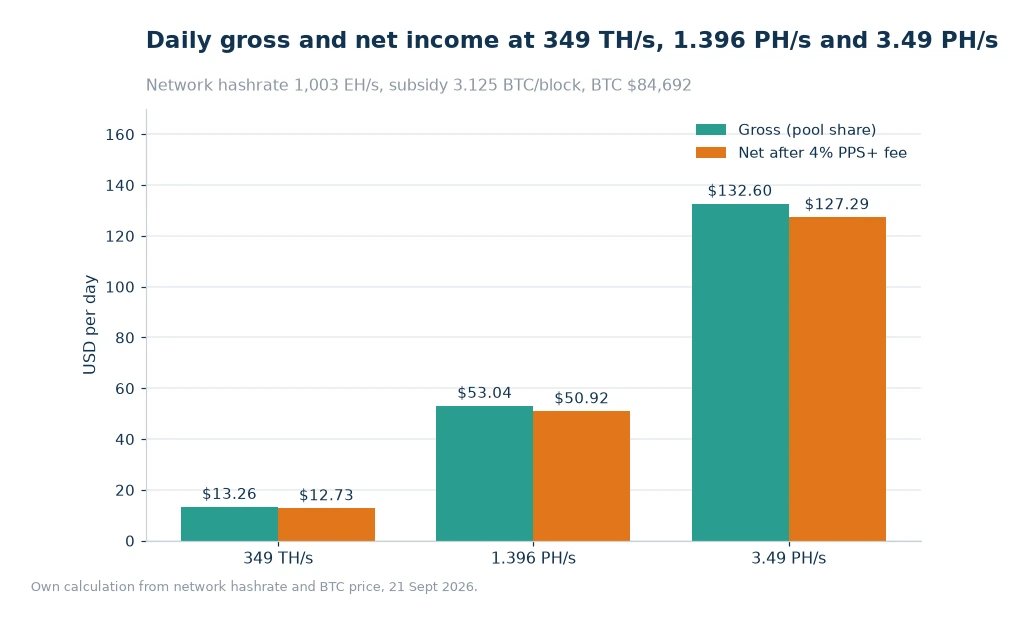
Follow one tier from network totals down to the figure the phone will show, then repeat it at the two larger sizes in the chart.
- Hashrate fraction of the network: 349 ÷ 1,003,107,267 = 3.47919e-7.
- 3.47919e-7 × 450 = 0.00015656 BTC a day.
- In dollars: 0.00015656 × 84,692 = $13.26.
- Strip the 4% listed on the block-reward portion: 13.26 × 0.96 = $12.73.
- Four units: 1,396 TH/s gives 0.00062624 BTC, or $53.04 gross and $50.92 net.
- Ten units: 3,490 TH/s gives 0.00156564 BTC, or $132.60 gross and $127.29 net.
- A five-day outage at the first size: 5 × 0.00015656 = 0.00078280 BTC, about $66.30 gross.
Setting the phone up before the taxi arrives
Do the installation a week early, not the night before. That gap lets you watch the alerts behave under normal conditions, so a notification on the trip has a baseline to be judged against. It also exposes the boring failures: a phone that sleeps the app, a notification channel muted by mistake, an account that logs itself out after a password change.
Log in once on mobile data with the home Wi-Fi switched off. If the login needs a code sent to a number you will not have abroad, fix that now. Then trigger a test alert by unplugging the rig for two minutes and confirm the message arrives on the phone rather than only in a browser tab.
The Statistics page is the other half of the picture, because it carries the pool and network figures that explain why a daily credit moved when nothing on the machine changed.
The ViaBTC App Download page carries the iOS and Android builds, and the same account works across both, so a spare handset can sit at home as a second pair of eyes. Multi-account support matters if you also watch a friend's rig: one login, several accounts, and a clear label on every notification.
Frequently asked questions
How much does a 349 TH/s rig earn in a day?
At 1,003 EH/s network hashrate it earns 0.00015656 BTC a day, worth $13.26 at $84,692, or $12.73 after the listed 4% on the block-reward component.
Is a phone enough to monitor a mining rig?
For a single unit, yes: real-time hashrate, a share timestamp and the hourly balance cover the three common failures, and a remote smart plug handles most of the rest.
How tight should the hashrate alert be?
Set it at 80% of the machine's own seven-day average rather than at a fixed dollar figure, so a network difficulty change does not produce a false alarm.
Set the alert, then get on the plane
One test cycle at home is worth more than any amount of reading about alerts. Unplug the rig, watch the message arrive, plug it back in, and confirm the balance resumes on the next hourly credit. If that loop works while you are standing in the room, it will work from another country.
Then write the plan down for the person at home: which plug to cycle, how long to wait, and when to stop trying. A note taped inside the door is a better monitoring system than a notification nobody on site understands.
Sources: ViaBTC app and calculator pages, for monitoring features and the listed 4%[1]. Network figures taken 21 Sept 2026 (1,003 EH/s hashrate, 132.76 T difficulty, 3.125 BTC subsidy, 144 blocks daily, $84,692 per BTC, next retarget −2.12%) and published 24 Oct 2026. Credit values assume the rig never stops.